How Music Therapy Helps Alzheimer’s Residents Feel Connected

How Music Therapy Helps Alzheimer’s Residents Feel Connected

At Bright Hope Adult Family Home, we are continually inspired by the transformative power of music therapy. For our residents living with Alzheimer’s and other forms of dementia, the world can sometimes feel fragmented and unfamiliar. Communication becomes challenging, memories fade, and a sense of isolation can creep in. Yet, amidst these challenges, we witness daily miracles of reconnection through melody and rhythm. Music therapy is not merely entertainment; it is a clinical, evidence-based intervention that taps into the deepest, most preserved parts of the brain, offering a bridge to lost memories, emotions, and, most importantly, to a feeling of belonging.

The Science Behind the Song

Why is music so uniquely powerful for individuals with Alzheimer’s? Neurological research provides a compelling answer. The areas of the brain that process music—particularly emotional responses to music and memory of songs—are often among the last to be severely damaged by the disease. A familiar song can bypass cognitive barriers and directly stimulate the limbic system, the brain’s emotional core. This is why a resident who may struggle to recall a family member’s name can often sing every word of a hymn they learned in childhood. The music acts as a neurological key, unlocking pathways to a sense of self that dementia cannot fully erase.

Fostering Connection: The Heart of Our Approach

At Bright Hope, our certified music therapist and dedicated care staff use this science to cultivate moments of profound connection in several key ways:

  • Evoking Personal Identity: We create personalized playlists for each resident, filled with music from their youth and formative years—the “musical biography” of their life. Hearing “their” music helps reaffirm who they are, combating the identity erosion caused by dementia. It sparks stories, names, and places long thought forgotten, even if just for the duration of a song.
  • Reducing Anxiety and Agitation: The soothing structure of a familiar melody can lower stress hormones and decrease periods of restlessness or anxiety. A calming lullaby or a gentle classical piece during afternoon care can transform a difficult moment into one of peace, making residents feel safe and settled.
  • Enabling Non-Verbal Communication: When words fail, rhythm and movement can take over. In group sessions, holding hands while swaying to a beat, or tapping a drum in unison, creates a powerful sense of community and shared experience. This non-verbal communion tells a resident, “You are not alone; we are here together.”
  • Encouraging Social Interaction: Group music therapy sessions are a cornerstone of our activities calendar. Singing familiar folk songs or holiday carols together often leads to spontaneous eye contact, smiling, and even harmonizing. These are moments of pure social connection, breaking the cycle of isolation.
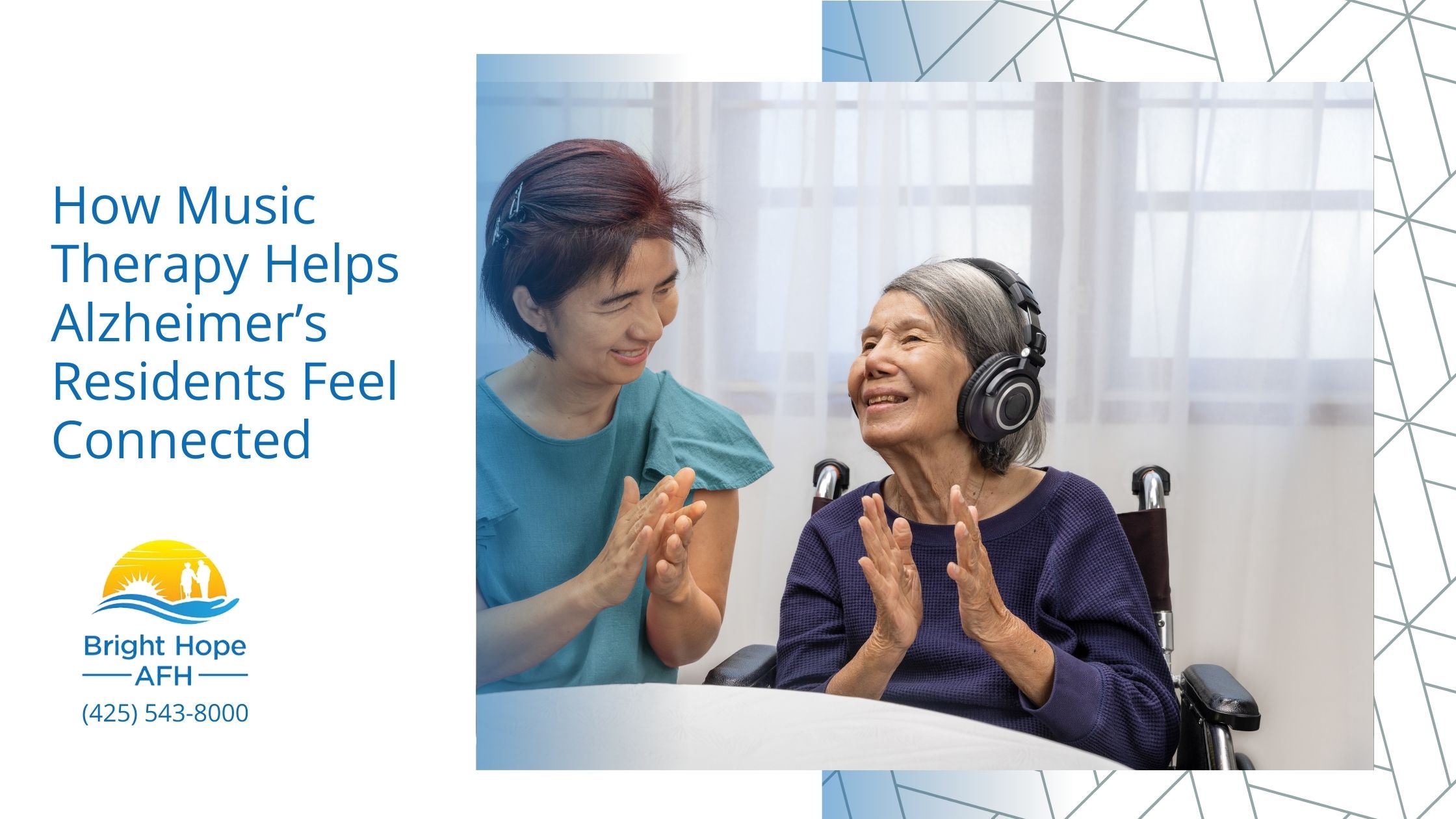
  • Spark of Joy and Engagement: Perhaps the most visible effect is the sheer joy. We see residents who are often withdrawn light up, tap their feet, clap their hands, and sing along. This active engagement is vital for emotional well-being and quality of life.

A Symphony of Care at Bright Hope

Our commitment at Bright Hope Adult Family Home is to see the person, not just the diagnosis. Music therapy is a vital instrument in our symphony of person-centered care. It allows us to meet residents exactly where they are. For some, it’s about quiet reminiscence; for others, it’s about joyful expression. Our team is trained to observe and respond to these individual cues, using music as a tool to facilitate connection on each resident’s own terms.

We integrate music seamlessly into daily life—whether it’s playing big band tunes during morning care, having a spontaneous sing-along in the living room, or using personalized headphones for a resident needing a moment of calm. It’s about creating an environment where the healing potential of sound is always present. To learn more about our holistic approach to dementia care, we invite you to explore our philosophy of care page on our website.

Witnessing the Transformation

The stories are endless and heartwarming. The resident who hadn’t spoken in days singing a clear line from a WWII-era love song. The husband and wife, both residents, sharing a tender dance to “their song,” reconnecting without a single word. The palpable calm that blankets a room when a familiar hymn begins to play. These moments are not just fleeting; they are tangible affirmations of life and spirit.

Music therapy offers what medications cannot: a direct line to emotion, memory, and identity. It reminds our residents—and reminds us all—that deep within, beyond the reach of disease, the core of a person remains, waiting for the right key to unlock it. Often, that key is a melody.

For more information on the clinical benefits and research supporting this work, a great resource is the American Music Therapy Association.

At Bright Hope Adult Family Home, we are honored to witness and facilitate these beautiful reconnections every day, proving that where words end, music truly begins.

Scroll to Top